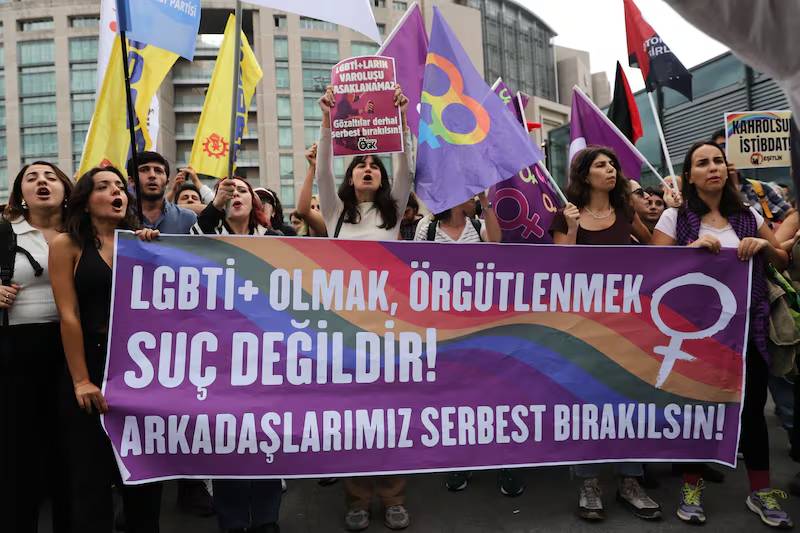
What is happening in Turkey in recent days marks a new and extremely serious escalation in the long-standing offensive led by Recep Tayyip Erdo?an’s government against LGBTQIA+ people and against the organizations that represent them and defend their rights.
Raids, searches of organizations’ offices and activists’ homes, seizures of digital devices, the blocking of websites and social media accounts, arrests and pre-trial detention. The operation launched by the Turkish authorities involves 162 people, nine associations and thirteen businesses across fifteen provinces. Following the arrests, the repression has also extended to those who took to the streets to protest: In Istanbul, 106 people were detained during the gathering in front of Ça?layan Courthouse. In Ankara, another 17 people were detained while attempting to make a press statement against the operations. They were taken to police stations, and there were also reports of physical violence against some of those detained. They were later released without being referred to the courthouse.
This is not an isolated incident.
For more than a decade, the space for freedom of LGBTQIA+ people in Turkey has been progressively restricted. Istanbul Pride has been systematically banned since 2015, demonstrations and events have been prevented or violently dispersed by the police, and anti-LGBT rhetoric has increasingly become an explicit part of the political discourse of the Erdo?an government. Human Rights Watch has documented how, as early as the 2023 election campaign, this rhetoric had become one of the tools used to polarize society around the defense of the so-called “traditional family”.
This is precisely one of the most worrying aspects: presenting the very existence of a minority as a threat to the family, to children, to morality or to national identity, in order to progressively turn that minority into a political target and restrict its ability to organize, demonstrate and speak.
It is a model that, in different forms and with different degrees of intensity, we have seen emerge elsewhere as well.
In Russia, the so-called “international LGBT movement” has been declared “extremist”, paving the way for criminal proceedings, arrests, the closure of organizations and persecution even for the simple use of symbols such as the rainbow flag. In 2025, prison sentences were also handed down for alleged participation in the movement.
In Georgia, laws adopted under the banner of “protecting family values and minors” have restricted LGBTQIA+ people’s rights to freedom of expression and association, as well as their access to healthcare and education. In Uganda, the Anti-Homosexuality Act continues to facilitate arbitrary arrests, blackmail, violence and discrimination.
In Europe too, in recent years, we have seen governments use opposition to LGBTQIA+ rights as a political tool. Viktor Orbán’s Hungary introduced laws restricting the representation of homosexuality and gender identities under the justification of protecting minors; the new Hungarian government has now proposed partially repealing those laws.
The contexts are different and should not be conflated. But the political mechanism must be recognized: when a State begins to decide which identities may be visible, which associations may organize and which ideas may be expressed in the public sphere, the issue no longer concerns only a minority.
It concerns democracy.
There is another element that we cannot ignore.
The construction of a minority as an internal enemy has too often been used to divert attention from the social and economic failures of a political system.
When inequalities grow, when work becomes poorer and more precarious, when access to housing, healthcare and education becomes more difficult, and when more and more people feel they have fewer opportunities than in the past, identifying someone to blame becomes a powerful tool for building political consensus.
Instead of questioning the policies that have produced precarity, the concentration of wealth in the hands of a few and the weakening of the welfare state, an identity-based conflict is manufactured: against LGBTQIA+ people, against migrants, against women demanding self-determination, against anyone who can be portrayed as different from a supposed norm that must be defended.
This mechanism takes on an even more serious meaning in the current crisis of the neoliberal model, which in many societies has produced greater inequality, the erosion of social rights and growing economic insecurity. When politics gives up on providing answers on wages, welfare, housing, public healthcare and the redistribution of wealth, the temptation to turn social hardship into fear of a minority becomes even more dangerous.
For this reason, we express our full solidarity with those who have been arrested and detained, with activists, with LGBTQIA+ and human rights organizations targeted in Turkey, and with all those who continue to defend their freedom despite intimidation and repression.
History teaches us that the rights of minorities are often the first frontier to be pushed back when a democracy begins to weaken. First, it is decided that a certain identity cannot be visible. Then that an association cannot organize. Then that a demonstration cannot take place. Then that certain ideas cannot be expressed.
And when it becomes normal to deprive someone of their freedom because they belong to a minority or defend its rights, the next step may concern political dissent, the press, trade unions, civil society organizations and the opposition.
For this reason, what is happening in Turkey today must concern all democratic and progressive forces.
As IUSY, we express our full solidarity with those who have been arrested and detained, with activists and with LGBTQIA+ and human rights organizations targeted by repression in Turkey.
We call on the European Union, the Council of Europe, the United Nations and international human rights bodies to use all available political and diplomatic tools to defend freedom of association, assembly and expression.
And we call on socialist, social democratic and progressive parties and on the organizations of the Socialist International to promote a common and concrete mobilization in support of Turkish civil society and the LGBTQIA+ organizations that have been targeted.
Because there can be no social justice without freedom, and there can be no freedom when rights depend on a person’s identity, sexual orientation or political views.
Defending today those who are portrayed as different means defending the democratic space of us all.
When the rights of a minority come under attack, it is never only that minority that is in danger. It is democracy itself that begins to shrink.